Our trip to down to North Carolina was a pleasant change from the long days we spent overly air-conditioned windowless reading rooms on our earlier academic voyages. (Though as should be evident from the slew of posts below, I clearly have no shortage of affection for the resources such halls contain.) We traveled to Beaufort, North Carolina to talk to David Moore, an nautical archaeologist who is currently excavating Blackbeard's flagship the Queen Anne's Revenge and an expert on Blackbeard. Because the popular imagery and myths surrounding Blackbeard have exerted a considerable influence on contemporary conceptions of pirates and piracy, Blackbeard, like Buccaneers of America, makes a good case to trace through history.
We learned several interesting and significant things in the course of this interview, including changes made to the 2nd edition of Johnson's A General History of the Pyrates which point to increased dramatization of the subject matter. At one point, the first edition has Blackbeard marooning some men on an island with no inhabitants or provisions; in the second edition, this account has been embellished to say that there was neither bird, beast, or herb for their subsistence -- an unlikely story given the presence of fresh water on North Carolina's Outer Banks. Even Johnson's famous description of Blackbeard indicates considerable dramatic excesses:
So our Heroe, Captain Teach, assumed the Cognomen of Black-beard, from the large quantity of Hair, which, like a frightful Meteor, covered his whole Face, and frightened America more than any Comet that has appeared there a long Time. This beard was black, which he suffered to grow of an extravegant Length; as to Breadth, it came up to his Eyes; he was accustomed to twist it with Ribbons, in small Tails, after the Manner of our Ramilies Wiggs, and turn them about his Ears. In Time of Action, he wore a Sling overe his Shoulders, with three Brace of Pistols, hanging in Holsters like Bandaliers; and stuck lighted Matchs under his Hat, which appearing on each Side of his Face, his Eyes naturally looking fierce and wild, made him altogether such a figure, that Imagination cannot form an Idea of a Fury, from Hell to look more frightening.According to Moore, the only eyewitness account of Blackbeard is in Henry Bostock's deposition where the pirate is desribed merely as "a tall, spare man with a black beard which he wore very long." We were also intrigued to learn that Moore knows when a new Pirates of the Caribbean movie has been released based on the sudden spike in interest in his work, mainly among schoolchildren working on history projects. He also equated the enthusiasm and excitement surrounding the finding and excavating of the Queen Anne's Revenge with the similar emotions evoked by Pirates of the Caribbean, which indicates just how strongly the contemporary popularity of pirates is linked to their historical origins (however historically inaccurate current representations may be). Moore also kindly provided with an excellent annotated bibliography of primary and secondary sources on piracy, making note of the ones that had passed his litmus test of credibility by getting the sections on Blackbeard right.
The interview was productive, the North Carolina Maritime Museum both free and informative, and the free day we spent at the beach sunny and relaxing. We also took a great deal of delight in the pirate-themed atmosphere that pervades the town of Beaufort:


The following day we headed back up to Raleigh, where the North Carolina Museum of History has an exhibit on piracy called Knights of the Black Flag, skillfully curated by the Maritime Museum who donated many of the artifacts on display from the Queen Anne's Revenge. We didn't learn much relevant to our project at the exhibit -- not through any fault on its part, but because we have spent the last three months immersing ourselves in this very material. In that sense it was a gratifying visit, and we certainly enjoyed seeing depictions of and artifacts from the stories we've been treating with such academic disinterest. Here is the pirate flag we designed on a computer there, using common symbols of piracy:


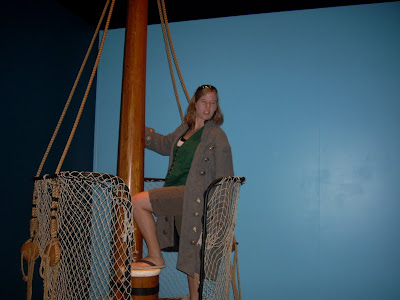
The definite highlight of the exhibit, however, was the hands-on section where they had pirate costumes to try on and a model pirate ship to clamber upon -- clearly necessary components of our research. Here is Catherine as Blackbeard:


And here are some pictures depicting serious scholarly investigation at the history museum: