THE BUCCANEERS OF AMERICA(N UNIVERSITY)
Comprising a Pertinent and Truthful description of the principal Acts of Research and Writing on the subject of representations of Pyrates
Showing posts with label somali pirates. Show all posts

Wednesday, August 12, 2009

Somalia and its pirates - back in the news again

While in Kenya last week, US Secretary of State Hillary Clinton pledged greater support for Somalia's incredibly weak transitional federal government, met with Somali president Sheik Sharif Sheik Ahmed, and threatened sanctions against Eritrea for supporting al-Shabab and the other Islamist militias which are reported by the Somali president himself to control all but a few city blocks of Somalia. In keeping with the tone of Clinton's remarks (including those made after the meeting), much of the recent coverage of Somalia has been focused on the threat of terrorism (including this interesting story about an attempt by a Minneapolis radio station to counter extremist propaganda with Somali-language VOA news coverage; apparently airing a program in produced by US public diplomacy is illegal in the US).

However, the renewed discussion of Somalia's identity as a failed state has obvious implications for addressing piracy off its shores. The recent rebirth of the Somali navy has attracted a moderate amount of news coverge, though a Coast Guard anti-piracy task force might be more effective. This BBC article on Somali's new Navy chief highlights the absurdity of commanding a Navy in the absence of a government, ships, equipment, and control of the coastline, but the Somali government has long maintained that training such a force is the best way to prevent piracy. Writing for Information Dissemination, Robert Farley suggests that the need for training represents an opportunity for the US to "influence the institutional development not just of the Somali Navy, but also of the various other navies of East Africa, and the rest of the world." The EU has already announced its plans to train a Somali anti-piracy security force, but it appears this would be distinct from the nascent Navy.

The relationship between shoring up Somali governmental institutions and the media focus on piracy cuts both ways. In a briefing on the semi-autonomous Puntland region published today, the International Crisis Group states that:
The [Somali] government must take advantage of the piracy-driven international attention to mobilise funds and expertise to carry out comprehensive political, economic and institutional reforms that address the fundamental problems of poor governance, corruption, unemployment and the grinding poverty in coastal villages. The international community needs to refocus on the long-term measures without which there can be no sustainable end to that practice or true stability. Equipping and training a small coast guard is obviously a necessary investment, but so too are other steps, such as to improve the general welfare and help impoverished fishing communities.
Meanwhile, a Turkish frigate working with NATO forces in the Gulf of Aden captured five suspected pirates today and is claiming to have prevented a possible ship hijacking, and the Hansa Stavanger, the German ship released last week, is headed home to Germany where Defense Minister Franz Josef Jung has called for a constitutional amendment giving German armed forces a greater role in hostage rescue situations, citing the length of time it took for German police forces to deploy to the Horn of Africa after the Hansa Stavanger was hijacked.

US officials too are worried about the threat of piracy in the Gulf of Aden. Citing dangers to US shipping (and thereby linking pirates to the "trade" commonplace in our analytical model), Elijah Cummings, Chair of the House Subcommittee on Coast Guard and Maritime Transportation, recently wrote an op-ed about his amendment to the National Defense Authorization Act that "would require the Department of Defense to place small teams of armed security aboard those few U.S. flagged ships truly at risk of being boarded when they carry U.S. government cargo through an area where there is a high risk of piracy." The House passed the Act and Cummings's amendment last month.

Pirate attacks in the Gulf of Aden are expected to increase in coming weeks with the end of monsoon season in east Africa.

Thursday, August 6, 2009

Salayan sailors and Somali swashbucklers

While there have been several news and human interest stories about US and European victims of piracy -- and several articles about the Somali pirates themselves -- the perspective of non-Western victims of piracy has not received the same level of coverage. However, the BBC has a radio report here about the plight of one Gujarati community whose maritime economy is being impacted by Somali pirate attacks, offering a more poignant perspective on the impact of piracy than that of higher insurance premiums and multi-million dollar ransom payments from large shipping companies.

Tuesday, August 4, 2009

Pirates of the Baltic?

While some are looking back to the Barbary Wars to make sense of the Somali pirate attacks, the tempting parallel for recent events in the Baltic Sea dates back to the Viking Age. According to Bloomberg, the Arctic Sea, a Finnish cargo vessel carrying a shipment of wood from Finland to Algeria, was hijacked in the Baltic Sea on 24 July. The crew was tied up and beaten while the pirates searched the ship, though it is not clear if they what they were looking for:

The Arctic Sea was en route to Algeria from Finland with timber when it was boarded between the Swedish islands of Oeland and Gotland in the Baltic Sea on July 24 by the group who identified themselves as police officers, Swedish police said in a statement today. The ship is owned by Oy Solchart Management AB, sails under Maltese flag, and has a crew of 15 Russians.

Sweden has provided warships and soldiers to the European Union’s anti-piracy operation, Atalanta, in the Gulf of Aden. Pirates have attacked vessels off the coast of Somalia 130 times so far this year, with 28 ships seized, the U.S. Navy has said.

Incidents like the detention in the Baltic Sea have never happened “in my life,” Victor Matveev, chief executive officer of Solchart, said in a telephone interview from Helsinki today.

“We’ve operated this vessel for many, many years on a consecutive voyage basis between Finland and the Mediterranean, and this is more than disturbing,” Matveev said. “All the crew members have been working for our company for several years, they’re professional, well educated, and there are no newcomers. It makes us wonder what happened.”

Monsters and Critics has a bit more detail:

According to the ship's 15-member Russian crew, the armed men claimed to be drug enforcement agents and thoroughly searched the ship, reacting violently to anyone who got in their way, including using a rifle butt to knock out teeth from one crew member. The ship was held for 12 hours before the hijackers men left again without taking anything. Investigators speculated that the 'pirates' may have actually been a drugs gang that was acting on a tip to search for contraband.

Meanwhile, in the Gulf of Aden, Somali pirates released a German ship, the Hansa Stavanger, and its 24-man crew after receiving $2.7 million in ransom from the owners. On Monday, a Malaysian-owned tugboat was also released.

Tuesday, July 28, 2009

Cutthroat Capitalism: too soon?

Wired magazine recently published an article called "Cutthroat Capitalism: An Economic Analysis of the Somali Pirate Business Model." There's nothing particularly novel here: that historical pirates are economic actors has already been observed, and this article is a clear-cut analysis of how that applies to Somali pirates. The article is based upon an interview with a Somali pirate and includes some rather nice charts and graphs. (I would like to contest, however, the idea that just because pirates are economic actors that this makes them capitalists: Like their historical antecedents, there is no production or exchange of goods and services going on; just extortion and robbery.) Wired has included "Cutthroat Capitalism: The Game" along with their article. Computer games about pirates are hardly new, and indeed, LucasArts has a new Monkey Island game out, but the goofy Guybrush Threepwood from Monkey Island is a far cry from today's Somali pirates.

In the Wired game, you are a pirate captain in the Gulf of Aden, sailing around and attacking different vessels. After a successful attack, you are supposed to negotiate for the release of the ship and hostages by choosing different tactics that include beating and killing your hostages to prove to the pirate negotiator you are serious about your demands. If you "successfully" negotiate, you are allowed to go back to roving the high seas. There are no EU or NATO ships, monsoon weather patterns, or possibilities for shipwreck and drowning in the game, and while not all attacks are successful, every vessel is presented as a potential target.

It's probably a testament to my incredibly limited experience with computer and video games that it took me six or seven negotiations before I overcame my squeamishness about clicking "beat" or "kill" as a negotiation tactic even for purely experimental purposes, but even without doing so, the whole game seemed more than a little sick to me. (Notice to potential voters in the incredibly unlikely event I ever run for anything ever: I do not think playing violent video games makes you a bad/evil/violent person.) So why am I perfectly happy to fire cannons at the bad guy pirate LeChuck in the Monkey Island game and so incredibly uncomfortable hijacking colored dots in the Cutthroat Capitalism game? The obvious difference has to do with the tone of the two games: Monkey Island is silly while Cutthroat Capitalism is deliberately realistic in approach (if not in graphics). Although both actions are something pirates "actually do/did," Somali piracy has yet to be tempered with that temporal distancing that we have identified as a condition of possibility for the romanticization of Golden Age piracy. Until this happens, I suspect the game will continue to feel a bit "off" to me, though judging from the comments posted below the game, this is not the case for many people who have played it.

That the game would involve acting as a pirate rather than as a US Navy SEAL or a NATO commander was equally puzzling to me, since first of all, there's precedent for this kind of thing and second, increases in piracy have historically resulted in nationalist opposition to the threat. Indeed, there is plenty of evidence that this happened when the Somali pirates hijacked the Maersk Alabama, Captain Phillips and the Navy SEALS were frequently described as heroes, and the media response was quick to draw upon the "pirate-fighters as patriotic heroes" commonplace we identified as prevalent in the early 1800s, with TV shows and movies featuring the Somali pirates as the villains. I think a possible answer to this puzzle is that the "pirates as cool and edgy" and "pirates as free from the constraints of society" commonplaces that coexist today alongside the "pirates as a security threat" have created conditions of possibility for the appeal of this game, since they have opened up a space in which pirates can be protagonists -- and enviable ones at that. If this is indeed the case, "Cutthroat Capitalism" is a telling example of how our perceptions of contemporary piracy are shaped by historical representations, since I do not think that this game (or a non-electronic version of it) could have enjoyed the same popularity before piracy came to be seen as a purely historical phenomenon.

Sunday, July 26, 2009

Pirates in church?

Well, in a UU church, anyway! Last Sunday, Rev. Louise Green at All Souls Unitarian Church gave a sermon on "The Inconvenience of Compassion" which began with an anecdote about feeling compassion for the Somali teenager, Abdiwali Abdiqadir Muse, who is being tried in New York for piracy. The sermon went on to play the rhetorical commonplace of "pirates as godless and evil" against teachings on compassion, and included a poem by Thich Nhat Hanh, a Buddhist monk, poet, and peace activist:
Please Call Me By My True Names

Do not say that I'll depart tomorrow
because even today I still arrive.

Look deeply: I arrive in every second
to be a bud on a spring branch,
to be a tiny bird, with wings still fragile,
learning to sing in my new nest,
to be a caterpillar in the heart of a flower,
to be a jewel hiding itself in a stone.

I still arrive, in order to laugh and to cry,
in order to fear and to hope.
The rhythm of my heart is the birth and
death of all that are alive.

I am the mayfly metamorphosing on the surface of the river,

and I am the bird which, wh
en spring comes, arrives in time
to eat the mayfly.

I am the frog swimming happily in the clear pond,
and I am also the grass-snake who, approaching in silence,
feeds itself on the frog.

I am the child in Uganda, all skin and bones,
my legs as thin as bamboo sticks,
and I am the arms merchant, selling deadly weapons to
Uganda.

I am the twelve-year-old girl, refugee on a small boat,
who throws herself into the ocean after being raped by a sea
pirate,
and I am the pirate, my heart not yet capable of seeing and
loving.

I am a member of the politburo, with plenty of power in my
hands,
and I am the man who has to pay his "debt of blood" to, my
people,
dying slowly in a forced labor camp.

My joy is like spring, so warm it makes flowers bloom in all
walks of life.
My pain if like a river of tears, so full it fills the four oceans.

Please call me by my true names,
so I can hear all my cries and laughs at once,
so I can see that my joy and pain are one.

Please call me by my true names,
so I can wake up,
and so the door of my heart can be left open,
the door of compassion.

I don't actually like the poem very much, but I have included it here as an example of a contemporary deployment of the "pirate as ultimate evil/hostis humani generis/enemy of all mankind" commonplace. That this common understanding of pirate is, to varying degrees, deliberately contested and refuted, both in the poem and in the wider context of the sermon, is actually further evidence of its being a rhetorical commonplace: In Civilizing the Enemy: German Reconstruction and the Invention of the West, Patrick Thaddeus Jackson takes great care to establish that a rhetorical commonplace is only weakly shared; it is a "potential resource," and "not a univocal, completely fixed bit of meaning that is identically possessed by multiple people; that would be a strong form of shared meaning, and ... would also have the logical consequence of making debate and discussion unnecessary: if we already agreed in this strong sense, why would we have to talk about it?" (28; 44; 50). Indeed, the sort of contentious conversations about representations of actors that Charles Tilly talks about in Stories, Identities, and Political Change are only possible with what he calls a shared set of idioms and history (116-118). Using pirates to demonstrate the possibilities of human compassion is an attempt to redefine the meaning of pirate, but such redefinition is only possible given that "pirates as evil" is already weakly shared among the congregation.

I feel like T-Rex explains this concept pretty well. (click to enlarge)

Tuesday, July 21, 2009

Research trip, part VI: Harry Potter and International Relations


(This is unfortunately not Platform 9 3/4)

As Catherine
noted some time ago, this project draws upon, among other analytical tools, the theoretical approach of popular culture as constitutive that is articulated in the introduction to Daniel Nexon and Iver Neumann's Harry Potter and International Relations. Primed as I was by a midnight showing of Harry Potter and the Half-Blood Prince at the Morehead City, NC cinema, I decided to read it was my turn to read HP and IR on the train ride back to DC. One can only spend so much time pretending that the Carolinian is the Hogwarts Express, after all, especially as Amtrak refuses to serve pumpkin juice and chocolate frogs in its snack car. My reading generated the following uh, articulation of righteous indignation, posted here as I am not sure what else to do with it. Caveat lector: There are virtually no pirates whatsoever in this post.
***

For the record, I do not automatically critically object to everything I read, my comments regarding
Peter Leeson's op-eds, Janice Thomson's footnotes, and deconstructionism notwithstanding. In fact, I thoroughly enjoyed many of the chapters in Harry Potter and International Relations, especially Ann Towns and Bahar Rumelili's chapter on the reception of Harry Potter in Sweden and Turkey; Maia Gemmill and Daniel Nexon's chapter on the religious politics of Harry Potter; Iver Neumann's chapter on the mythical geography of the magical world; and Martin Hall's chapter on mythology as methodology. However, Jennifer Sterling-Folker and Brian Folker's chapter, "Conflict and the Nation-State: Magical Mirrors of Muggles and Refracted Images," got my goat.

Setting aside for a moment the theoretical conclusions they draw by equating the conflict with Voldemort with a nationalist war, my first gut-level reaction to the chapter concerned the authors' unqualified use of the term "mudblood" to describe Muggle-born wizards (117). As anyone who has even skimmed
Chamber of Secrets ought to know, "mudblood" is an incredibly derogatory term in the wizarding world, inciting a violent response from the entire Gryffindor Quidditch team when Malfoy uses it against Hermione. There are numerous other examples of the non-neutral connotations of the term from Snape's calling Lily Potter a mudblood in a remembered scene in Order of the Phoenix (a key plot point) to its wide-spread use in the Ministry of Magic after Voldemort seizes control of that particular state institution (more on that later). The obvious equivalent in the muggle world is, of course, the word "nigger," and the parallel becomes particularly acute with Hermione's bold and deliberate reappropriation of the term in Deathly Hallows.

It is odd, then, that not only do the authors cavalierly use the word "mudblood" when "Muggle-born" is clearly the appropriate term within the fictional social context the authors are analyzing, but they go on the explicitly equate the widely-used and value-neutral term "Muggle" with "nigger" (119). While I will grant that wizards often take a paternalistic tone in describing Muggles (and a downright evil one in the 7th book, though the authors could not have known that when writing the chapter, of course) the term "Muggle" itself is widely used by good and evil characters alike in the wizarding world. Indeed, the paternalistic tone the authors refer to is, I would argue, a deliberate literary device that adds some humor to the books (Mr. Weasley doesn't know how electricity works! Archie can't figure out the vagaries of Muggle dress!) and even a way to get young muggle readers thinking critically about their own taken-for-granted cultural norms in the tradition of "Body Ritual Among the Nacirema." Hermione, who clearly loves her parents very much, refers to them as Muggles; Hogwarts offers a class in Muggle Studies; the pre-Thicknesse Ministry of Magic had departments with "Muggle" in the name; even Dumbledore, the embodiment of goodness, talks of Muggle knitting patterns. Indeed, the lack of another term for non-wizarding humans points to the innocuous ubiquity of the term "Muggle." In short, there is nothing to support the authors' statement that "Muggle" is in any way a derogatory term.

These are two fundamental errors of empirical analysis in this chapter of
Harry Potter and International Relations. There is no real question of interpretation here; while the precise wizard-Muggle relationship is debatable, that "mudblood" is "a disgusting thing to call someone" and "a really foul name" is not. This type of misreading has two implications: First, it seriously detracts from the authors' credibility in their analysis of Harry Potter and international relations. Either they did not read the books at all and relied instead on secondary sources, or their reading was superficial and ignored the nuances of wizarding social identities. My insistence on this seemingly small linguistic point may sound laughably nerdy and pedantic -- and indeed a social science analysis of a transparently constructed fictional world is always going to be subject to that sort of critique -- but the authors' decision to treat the world of Harry Potter as worthy of academic analysis effectively moots such critiques in this debate. I also felt this misuse of terms detracted from the overall credibility of the book; that sort of misreading should have been flagged by an editor or reviewer. Since the editors of the book were clearly targeting a Harry Potter-literate audience, they should have known to hold their contributors to the same standard.

The second implication of this linguistic imprecision is that it is indicative of a deeper misreading of the Harry Potter texts. Chief among these is the authors' equation of the wizarding world's conflict with Voldemort with identity-based (nationalist, religious, ethnic) conflict in the Muggle world. The authors argue that the fundamental difference between the liberal IR fantasy of the wizarding world and the realist reality of the Muggle world is that in the wizarding world power inheres to the individual and therefore the need for collective action is minimized. The authors' then state that there should be "relatively little cause for collective conflict among wizards and witches themselves as a result," and use this as evidence of the logical inconsistency of Rowling's "ultimate fantasy of liberal philosophy." They are correct in stating that there should be little collective conflict; in fact, there is not.


The problem lies not in Rowling's logic but in their reading of Voldemort's war against elements of the wizarding community as a collective conflict, on par with the Nazis' quest for racial purity. There are parallels, to be sure, and the Harry Potter series is nothing if not a call for greater tolerance in the world, but Voldemort's primary concern is not with creating an exclusively pureblood race (Voldemort himself is a half-blood). While blood purity is certainly the goal of the Death Eaters whose service he needs, Voldemort himself is obsessed with becoming the greatest wizard of all time by overcoming death. (In Rowling's fictional universe, it is occasionally possible to determine a character's motivations directly, but even without relying on a motivational account for Voldemort's actions we can conclude that the image he has crafted for himself is that of a wizard obsessed with power at all costs). The conflict in the Harry Potter series is not between purebloods and half-bloods (in any case, that only starts to become the case in the 7th book, which the authors did not know about); it is between Harry and Voldemort. It
is a highly individualized conflict and whether or not that is a liberal fantasy, it is emphatically not an identity-based conflict in the model the authors envision.

The authors' concluding point is that the wizarding world has no link between identity and collective political structures, and this is why Voldemort and the Death Eaters never make an attempt to "seize the reins of power that the state embodies." But if the conflict in the series is read as something other than a collective identity-based movement, there is no immediate need for its instigators to gain state control. It seems to me that a more apt reading of the conflict is that of a lone wolf terrorist or a small guerilla movement that is intent on achieving a deluded, highly individual goal or acquiring power with no wider social agenda. This does not imply that Voldemort's actions do not have broader societal implications; because he does not care who gets hurt in his pursuit of power and because a climate of fear only makes his exercise of power easier, many, many people can and are maimed, killed, and tortured along the way.

The authors of the article write that "the seizure or control of the state is the means whereby muggle collectives can obtain goals such as racial purification and oppression that involve violence en mass [sic]" (122). But since racial purification and oppression are not Voldemort's chief concerns, except as means to an end, it makes sense that taking control of the Ministry of Magic would not be his primary goal, particularly since, as the authors note, the Ministry has only limited power in the wizarding world anyway. Here is where the inevitable and admittedly mediocre pirate reference comes in: desperate for to obtain some sort of power (at least of the economic flavor) but largely unconcerned by larger identity-based social concerns, the Somali pirates are not targeting the incredibly weak Somali government or any government at all. I do not in any way want to equate the Somali pirates with Voldemort's evilness; I merely wish to point out that targeting the state is not always the best way to become powerful, especially when you are starting from ground zero.

Ultimately, of course, Voldemort and the Death Eaters
do gain control of the Ministry through holding Thicknesse under the Imperius Curse, literally turning the Ministry into a puppet government and the wizarding world into a police state, though -- in fairness -- the authors of the chapter could not have known this when they were writing. Once the wizarding world accepts that Voldemort is back, spreading fear is a good way for Voldemort to gain power, and control of even weak state institutions helps make this possible. That it would take so long for Voldemort to infiltrate the Ministry is thus indicative of the following: his primary concern with personal power and thus his relative unconcern for collective identity politics (personal power, at least in its early stages, does not require control of the state); the physical and social limitations of his power in the earlier books (does anyone really think Voldemort could infiltrate the Ministry of Magic when he didn't even have a body of his own?); and presumably also the fact that control of state institutions is a subject of little interest to most 10-14 year olds: the audience of the earlier books.

The broader point I wish to make here is that a cursory or incomplete reading of text to support a broader theoretical commitment fails at creating a compelling case on two levels: First, it destroys a scholar's credibility and authority on a given subject; and second, it leads to empirically flawed analysis that does little to support the theory in question. And on a much lower third level, it opens you up to criticism from 20 year-old IR students who grew up reading and re-reading the texts in question and do not like to see them carelessly wielded.


On that note, this quote from Dumbledore seems a particularly apt way to end this post, with its wonderful constructivist overtones* and its recognition the power of myth and story:
That which Voldemort does not value, he takes no trouble to comprehend. Of house-elves and children’s tales, of love, loyalty, and innocence, Voldemort knows and understands nothing. Nothing. That they all have a power beyond his own, a power beyond the reach of any magic, is a truth he has never grasped. (Harry Potter and the Deathly Hallows, 710)
*Dumbledore himself might be more of an interpretivist, however:
"Tell me one last thing," said Harry. “Is this real? Or has this been happening inside my head?” “Of course it is happening inside your head, Harry, but why on earth should that mean that it is not real?”

Wednesday, June 24, 2009

Something for everyone!

Pirates can, in fact, be connected to pretty much anything, but to demonstrate pirates' broad-based appeal, a quick round-up of piracy headlines, before we head to the collections of the Mariners' Museum in Newport News.

For the military technology geek: The Vienna-based company Schiebel Group, known for its work with mine-detection and UAV technology is, as Danger Room notes, advertising a robotic helicopter as a pirate detection system.
The three-year-old Camcopter design is popular with organizations working to “de-mine” old battlefields, and with oil companies, for pipeline monitoring. But the 10-foot-long, 200-pound bird, can also be flown from tankers and other large vessels, in order to search ahead for pirates, according to Schiebel. The company told Aviation News, in June, that a Saudi tanker operator has already “shown interest” in buying Camcopters for Somalia duty. But it’s worth noting that the US Coast Guard stresses alert watchmen, sailing fast, and pulling up a ship’s ladder — not some expensive technology – as the best methods for beating pirates.
For the type of people who read the Foreign Policy blogs every morning: Japan's parliament has authorized the use of force by the Japanese Navy against Somali pirates, raising more questions about the future of Japan's pacifist constitution.

For people interested in international maritime law
: A NATO warship recently captured a group of pirates who tried to hijack a Singaporean freighter, stopping the hijacking with no casualties but later releasing the pirates. NATO has been criticized before for being too gentle with captured Somali pirates, and the organization does not have a detainment policy; the arresting warship must follow its own national laws.

For readers of biography: The Providence Journal published a biographical sketch of Thomas Tew, a late 17th century pirate and privateer, who operated off the coast of Africa, raiding Mughal ships. Probably.

In the 17th century there was a pirate from Rhode Island. Or perhaps he was a privateer. Maybe he wasn’t from Rhode Island after all. These are the kind of “facts” that float to the surface when one stirs the murky brew of hand-me-down history that has fermented for centuries, from a time when legend often was prized over fact, and records, if kept, have crumbled to dust.
As Catherine noted the other day, however, the beauty of our project is that it doesn't actually matter who Tew really was or what he really did. Intersubjective understandings and cultural representations of piracy are based on myth-making. What's interesting here is the continued interest in Tew's roguish deeds -- not whether Tew actually did them.

For the history buff: There's a movement afoot in Scottish Parliament to clear Captain Kidd's name following research that indicates that Kidd may have been framed by King William III, "
who wanted to appear tough on piracy but who also stood to profit from the goods which Kidd seized." The tale of Kidd's hanging is pretty grisly -- the rope snapped the first two times -- and his body was tarred and hung along the banks of the Thames as a warning. The Scottish MP behind the motion has cast it in terms of justice, noting the problematic ambiguity of the privateer/pirate distinction:
"I think these types of incidents, whenever they happen, have a lesson and a morality for all time because otherwise we allow people to get away with breaking the law and breaking rules and we allow governments to get away with punishing people wrongly. I don't expect that there's going to be a mass campaign in the streets for something that happened 300 years ago but I do expect that people are going to be worried about the fact that someone can be used and abused in that way by the state, whatever time in history. If someone is accused and hung for something that he didn't actually do, when he was operating for the government and he was doing the job properly, that comes down to a criminal act on the part of the government not on him."
For the local TV viewer like you: The Discovery Channel and the Military Channel recently aired a program on the capture and rescue of the captain and crew of the Maersk Alabama, with a local man from Norfolk, VA playing the role of Abduwali Abduqadir Muse, the accused pirate awaiting trial in New York.

Sunday, June 21, 2009

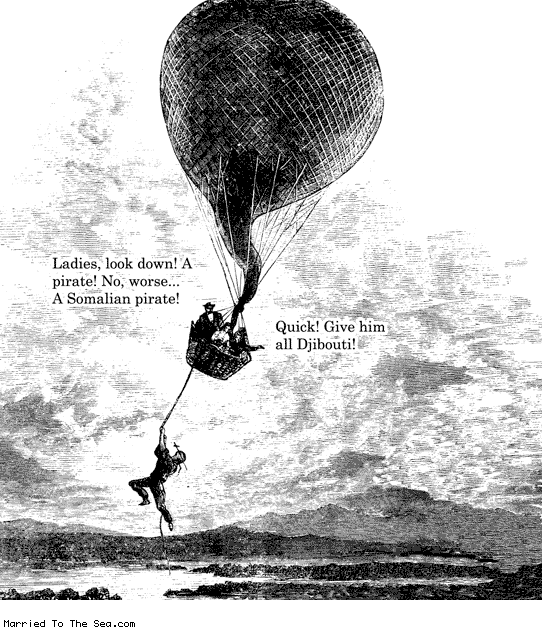
Threat of piracy ballooning off Africa's eastern coast

We recently finished a (very) rough draft of our theory and methods section, so rather than a post involving actual words and ideas, here's a cartoon instead, courtesy of Fletcher.


http://www.marriedtothesea.com/061109/somalian-balloon-pirate.gif

Thursday, June 18, 2009

Reporting live from Puntland

Al Jazeera's English-language series of reports on piracy called "Pirates' Haven" is one of the best in-depth account of Somali piracy that I have come across. Al Jazeera's East African correspondent Mohammed Adow travels to Bossasso and Eyl to interview pirates, governmental officials, and others in an effort to contextualize more fully the pirates that, as Adow notes, have been captured mainly in the headlines.

The first part takes a look at the Puntland region and the conditions that originally facilitated piracy as a business and continue to fuel it today:


Part 2 examines the system of hostages and ransom payments inherent in piracy, and Adow documents local reactions -- and objections to -- piracy in the town of Eyl.


BBC's Africa correspondent Andrew Harding also visits Puntland to report on the fight against piracy in Somalia:


Meanwhile, anti-piracy efforts continue apace outside Somalia as well. Interpol is currently working on compiling a database of Somali pirate suspects:

"Without systematically collecting photographs, fingerprints and DNA profiles of arrested pirates and comparing them internationally, it is simply not possible to establish their true identity or to make connections which would otherwise be missed," Interpol's Executive Director of Police Services, Jean-Michel Louboutin, said in a statement released Wednesday at the agency's headquarters in Lyon, France.

Sunday, June 14, 2009

Piracy as the high-profile tip of the Somali iceberg

The BBC recently published an excellent article and accompanying radio report on the hijacking of the Danish merchant ship the CEC Future. Rob Walker interviews both the ship captain and crew, some incarcerated pirates, and Ali Mohamed Ali, the same pirate negotiator that struck up an unlikely friendship -- reported by NPR -- with shipping executive Per Gallestrup. He goes on to detail how the ransom payment was parachuted down to the hijacked vessel (a surprisingly tricky business), the dynamics between the pirates' captain, Omar, and his crew, and the economic benefits the Somali port town of Eyl has accrued as a result of piracy. Information about the mechanics of Somali pirate attacks can also be seen in Eagle1's post about the attack on the Dubai Princess which includes a series of photos capturing exactly what an attack by RPG-armed pirates in a speedboat looks like. The upcoming Samuel L. Jackson action movie about pirate negotiator Andrew Mwangura demonstrates a similar interest in the workings of the Somali piracy phenomenon.

John Boonstra, from UN Dispatch, would perhaps approve of this interest to the extent that it ultimately draws attention to Somalia's growing humanitarian crisis, which has resulted in over 100,000 internally-displaced persons. Boonstra quotes Italian Foreign Minister Franco Frattini:
"Piracy is only the tip of the iceberg," Frattini said. "We are convinced that piracy is related to the political and socioeconomic crisis on land, not on the sea.
Boonstra notes, however, that the iceberg is "much, much bigger" than current steps (calls for international coordination, the establishment of pirate courts, and a Somali coast guard) are addressing, and he states that, "Compared with the widespread travesties faced by these thousands of Somalis, the international community's focus on piracy, whatever its impact on the global economy, seems almost an affront to human dignity. " But as Frattini's statement hints at, continued interest in the region and the piratical tip of the iceberg -- whether expressed in respected news media, the blogosphere, or Hollywood -- carries the possibility of increased awareness of the wide-spread human rights violations, violence, and war crimes. Given that the Somali pirates continue to hold a large number of vessels and appear to be expanding their range of attacks to the Persian Gulf, piracy is likely to stay popular in the news and culture, but whether the attention given to Somali's humanitarian problems will go beyond the following prerequisite cursory nods remains to be seen:
  • "Somalia has been without a stable government since 1991, allowing piracy to flourish." (BBC)
  • "The pirates in the recent string of attacks are all from Somalia, an extremely poor African country that hasn't had a stable government in decades." (Washington Post)
  • "Piracy has become a multimillion-dollar business in Somalia, a nation that has limped along since 1991 without a functioning central government." (The New York Times)

Tuesday, June 2, 2009

Mamas, don't let your babies grow up to be pirates

The BBC has an excellent report about local anti-piracy efforts in Somalia's Puntland region. The article offers some interesting insights into how piracy is viewed in Somalia and offers a sobering account for why perceptions of piracy matter very much in the "real world." While we may amuse ourselves with kid-friendly portrayals of pirates on Sesame Street, in Somalia, a "kid-friendly" image of a pirate is deeply troubling:
The 40,000 people who live in camps like 100-Bushes across Puntland have drifted in over the years, seeking refuge from the apocalyptic horrors in southern Somalia - civil war, drought and famine. Out here, there are no jobs. Only one in three children are in school, and the future for most is anything but promising.

No wonder then that mothers like Mumena Abdur Qadir are worried about their children - either that they will end up just as poor and destitute as their parents or that they will become pirates. "They drive around in expensive cars, they offer our sons lots of money, so of course piracy is an exciting option," she says. "But nobody likes them any more, and now it's really dangerous. The (French and the Americans) have been killing pirates, so we think it's a really bad thing to do."
Mumena Abdur Qadir's worry is valid, as a recent Reuters article discussing Somali perceptions of piracy indicates:
Abdihafid, 13, dropped out of school, ran away from home and has taken up chewing khat and smoking cigarettes like the many brigands he sees in Hobyo."I want to be a commander of a pirate group," he said. "I know I am far too young, but I will wait until the right time."
The Reuters article also discusses the, well, romantic implications of the romanticization of piracy, echoing earlier reports on pirates' sex appeal:
An extravagant convoy of forty 4x4s and four motorbikes escort a young bride to her nuptials at a sandy beach in the Somali village of Hobyo and are used to light up the twilight celebration.Her pirate commander groom has no eye patch -- but a sword and knife hanging from his belt do create a swashbuckling effect. "I am proud to be the leader's wife," said Sahra ... [L]ocal girls are finding it hard to resist the monied pirates. "I don't want to marry a pirate but time is flying and pushing me to have a pirate boyfriend because he is rich," said Halima, who at 24 is considered a bit too old to be single.
According to the BBC article, Abdifatah Hussein Mohamed, an activist with the Puntland Students' Association, objects to this idealization of piracy and has been working hard in the region to convince other young people to just say no to piracy by deliberately reshaping the image of a Somali pirate:
When they began, Somalia's pirates cast themselves as "Robin Hoods of the sea" - as defenders of the nation's fisheries, first chasing away and later capturing foreign trawlers that had been looting the country's rich and unpoliced seas. Much of the money they took as "fines" went back into local schools, hospitals and businesses. No longer.

"They're responsible for so many problems," said Abdifatah Hussein Mohamed. As an activist with the Puntland Students' Association, Abdifatah and his friends have created a multi-media empire. From their stuffy, cramped headquarters in central Bossasso, they churn out TV programmes, radio shows, magazines and websites with a single, simple message - piracy is out.

"First, they are responsible for inflation," he complained. "Now, food, land, cars are all too expensive for ordinary people. It used to be that you could hope for these things, but not any more. Then, they bring in prostitutes, they take drugs, they crash their cars. They rape whoever they want and nobody can do anything about it. Nobody wants them around any more."

His friend, Mohamed Jama agreed: "They are causing a lot of problems in the family. Sometimes women go with them because they promise lots of money. But they also divorce their wives very quickly too. It's bad for everybody."

As the article notes, however, rhetorically and socially isolating pirates is not likely to solve the problem on its own. International efforts are needed, and while many international associations (most recently the G8 and the Contact Group on Piracy off the Coast of Somalia, which comprises the US, the UN, the EU, and NATO) have agreed with the need to coordinate responses, the Puntland administration maintains that working with the transitional federal government in Mogadishu is, for obvious reasons, unlikely to have much effect:

"So many governments promised to help fight piracy on land, and that's a good thing," [President Abdirahman Mohamed Farole] said. "But they are all talking to the central government in Mogadishu. That's a policy decision, but it is a waste of time.

"The TFG (transitional federal government) only controls a piece of Mogadishu. They have no authority up here. So the rest of the world has to recognise that there are two legitimate governments in northern Somalia - Puntland and Somaliland - and deal directly with us if they want anything done."

And while both the US and the international community are claiming (limited) success in the war against piracy, this report from the Christian Science Monitor indicates that piracy continues to be profitable. If it's any consolation to the US Navy (here is an in-depth if slightly sprawling analysis of the modern role of the Navy in a purportedly post-naval era), anti-piracy efforts in the Straits of Malacca appear to be working, though as Elizabeth Dickinson points out, these successes are unlikely to be repeated off the Horn of Africa:
First, none of the countries in the Pacific are failed the way Somalia is -- meaning that the countries could also combat the core of the problem on land, without fearing a "safe haven" ashore. Not so in Somalia, where pirate havens are essentially untouched.

Even more important, while lots of countries want piracy in the Gulf of Aden to stop, no one or two of them are at such peril that they want to invest the resources to get the job done. In the Pacific, the three countries' economic survival as port hubs depended on their safety. No such pressure in Somalia.

Except, perhaps, from a small, student-led group of anti-piracy activists, whose concern with the perception of contemporary piracy goes well beyond our own academic puzzlings. We wish them the best of luck.

Saturday, May 23, 2009

A(nother) Disney movie in the making

First there was speculation over the Hollywood-esque rescue of Captain Phillips, then the announcement of the Spike TV series, then Samuel L. Jackson's Somali pirate movie. Now, from NPR's All Things Considered, comes this extraordinary and heartwarming story of an unlikely friendship between a Danish shipping executive and a Somali pirate negotiator, forged over phone and e-mail, and cemented with the gift of three baby camels. Humanizes pirates like never before! A fascinating glimpse inside the lives of those driven to desperation! Two thumbs up! (You can listen to the full version of what is actually an interesting and well-reported story here.)
They dropped the money for the pirates from a helicopter on a Friday morning. Shipping executive Per Gullestrup's crew was released and headed home. The pirates, in the Gulf of Aden, headed off.

But the next morning, Gullestrup was in his kitchen in Copenhagen when his cell phone rang. The caller was "Mr. Ali," the pirate negotiator who says he is known on dry land as Ali Mohammed. "When he got ashore and got back to his home in Somaliland and he called me, initially, funnily enough, it was almost a courtesy call," says Gullestrup, CEO of the Clipper Group. "He just wanted to say he'd gotten back home."

That surprising call marked another step in an unusual working relationship, between a bargainer for pirates demanding a $7 million ransom and the businessperson trying to save sailors' lives. "We started talking because I was curious about the inner working of the system ... and he was very forthcoming with that," Gullestrup says.

Over the course of their conversations, Gullestrup asked about the pirates' thinking when they lowered the ransom figure. Gullestrup won't say exactly how much the company paid, only that it was between $1 million and $2 million.

For his part, Mohammed says he was curious about the shipping company's bargaining strategy, and that the men have continued to e-mail back and forth — two or three times a day.

"We talk about the issues of piracy or this or that," Mohammed says.

Their experience speaks to business negotiations everywhere, which leave the parties not necessarily as adversaries. Gullestrup is operating in circumstances where he is essentially on his own. He can't expect military help when and where he needs it.

Pirates, meanwhile, are colluding, sharing intelligence in an unregulated environment. Economists would say the dynamic centers on market power. The situation makes it hard for a shipper like Gullestrup to figure out the market rate for ransom.

"The owners are escalating the ransom payments because they're not coordinating how to deal with pirates," Gullestrup says. "The pirates are extremely good at sharing information. We know for a fact from Ali the pirates have piracy workshops. Pirates of various clans, [their] elders are getting together and they will exchange information."

Mohammed says he gets something out of the relationship, too. He doesn't see himself as a pirate. He says he agreed to negotiate for pirates so he could learn enough about their business to start his own.

"If I become an expert on piracy and try to milk that, I think it is a legit business," he says. "The news media and global news media will need someone who is going to be an authority, to report from the inner feelings of a pirate, and to report whether pirates are going to stay around for a long time or not, and how to eliminate piracy."

Gullestrup sounds satisfied with that arrangement. "We tried to help him by giving him credentials as an expert in piracy locally, and he's trying to establish himself as a piracy consultant. It's a quid pro quo," he says. "It's not like we're bosom buddies. It's a business relationship."

The executive expresses a certain appreciation for Mohammed's character. "He's a very kind person, and he has a wife and a son," Gullestrup says. "He has a large herd of camels. He sent me an e-mail that said he allocated three camel babies to me, for which I'm honored."

Mohammed called the gift a good gesture. "It's those little things that count."