THE BUCCANEERS OF AMERICA(N UNIVERSITY)
Comprising a Pertinent and Truthful description of the principal Acts of Research and Writing on the subject of representations of Pyrates
Showing posts with label film. Show all posts

Saturday, August 1, 2009

Captain Blood .... in Space!

We've been meandering our way through some famous pirate movies of the early 20th century this summer (since the pirate discourse shifted to the silver screen from the 1920s onward) and one of the less interesting pirate movies we've watched has been Captain Blood. Although it held great promise, what with the dashing charms of Errol Flynn, the background of the Monmouth Rebellion, a man named Blood, and swashbuckling on the high seas, it was actually marked only by the quicksilver shifting of the protagonists' motivations and character, the incomprehensibility of the plot, and a grand total of one somewhat lackluster sword fight. (Please note this is not a sneering condemnation of old movies held up against the glittering, CGI-enhanced jewel of Pirates of the Caribbean; The Black Pirate from 1926 was an infinitely more exciting film with several way-cool sword fights.)

However, in complete disregard for my lousy review, it turns out that Warner Brothers are playing to remake Captain Blood ... by setting it in outer space! Producer Bill Gerber explains:

"When it comes to swashbuckling, you just couldn't go back to the pirate era, not once you've experienced the juggernaut that is 'Pirates of the Caribbean,' '' he explains. "So we needed to find a new way to tell the story."

For Gerber, the best option was not a present-day story involving the Somali pirates -- who are probably too vile and desperate to base an entertainment around -- but a story set a couple of hundred years in the future. "It's still the classic 'Captain Blood' storyline: Peter Blood has been wronged by the powers-that-be and he wants to get even. But the best way to recreate that is by putting it in space, where you can have a totalitarian style of government that's actually pretty similar to what England was like in the 17th century."

This is some pretty informative commentary, as it notes both the shifts that happened in contemporary pirate discourse that accompanied Pirates of the Caribbean as well as the Somali pirate attacks. And while I'm a bit skeptical of sword fights in outer space, there's precedent for space pirates and Geoff Boucher imagines a "live-action version of the Disney film Treasure Planet" which was sort of ok. Ultimately, there's no doubt that, far from being "a partnership that never should have begun," the new Captain Blood has the potential for great box office success, bringing together as it does three of America's favorite things to watch on screen: space, pirates, and (if this LA Times blogger has his way) Robert Pattinson.

Here, for your entertainment, is the swashbuckling scene from the 1935 Captain Blood (skip ahead to 3:44):

Monday, July 20, 2009

Research trip, part III: Fictional pirates in Mystic, CT


The first books I looked at in the Mystic Seaport library were a couple early editions of Treasure Island (first published in 1883), one from 1931 and one from 1949. The 1931 edition included a rather romanticized biography of Robert Louis Stevenson ("He inherited from his father a genial humor, a touch of Celtic melancholy, a sensitive conscience, a fondness for dogmatic statement, and a love for romance and for open-air activity; from his mother, a brilliancy, vivacity, and native grace, and a feminine sensitiveness to impressions; from her, likewise, a frail body and a predisposition to pulmonary disease, which he never outgrew, and which condemned him to a life of invalidism.") and also speculated as to popularity of Treasure Island at the time of its writing:
The major passion ... found little place in his stories; and his few women were not altogether satisfactorily drawn. For it was not love with its rewards and circumscribed plots and self-sufficiency that set best Stevenson's genius; but life with a hazard -- life kinetic under an open sky and on a broad field, full of struggle and "tailforemost morality"; life so circumstanced that the characters, driven forward through clean open-air adventure, act their parts in obedience to natural impulses and practical intelligence without the hesitations of conscience or the halting at questions of conduct ... Stevenson came at a time of 'spiritual fatigue'; when literature had lost much of its freshness and vigor, and was busy puzzling out the weightier problems of existence ... And the world, long since wearied by introspections and abstractions, was ready to turn away from gloomy forebodings to a more joyous mood.
I'm not sure about the "spiritual fatigue" of the world, but certainly the association of pirates with a life of freedom from societal constraints has enjoyed long-standing popularity, manifesting itself today in insane libertarian schemes as those of the Seasteading Institute.

The early 20th century offered much in the way of speculation as to the popularity of pirates. Joseph Lewis French's 1922 introduction to Great Pirate Stories offers several interesting insights. The first of these is French's recognition of the important role temporal distancing plays in the romanticization of the men he himself calls savages:
There may be a certain human perversity in this, for the pirate was unquestionably a bad man -- at his best, or worst -- considering his surroundings and conditions, -- undoubtedly the worst man that ever lived. There is little to soften the dark yet glowing picture of his exploits. But again, it must be remembered, that not only does the note of distance subdue, and even lend a certain enchantment to the scene, but the effect of contrast between our peaceful times and his own contributes much to deepen our interest in him.
A second point to take from French's introduction is that in the early 1900s, piracy was seen as an almost exclusively historical phenomenon:
It is said that he survives even today in certain spots in the Chinese waters, -- but he is certainly an innocuous relic. A pirate of any sort would be as great a curiosity today if he could be caught and exhibited as a fabulous monster.
A final work of fiction worth mentioning was "The Pirate," published in an 1836 collection of stories entitled The Naval Annual: Or, Stories of the Sea. Both the description of the pirate ship and of the pirate captain (one Captain Cain) are indicative of the imagery associated with pirates at the time and that continues to hold sway. First, the description of the pirate ship the Avenger, which calls to mind Blackbeard's flagship, the Queen Anne's Revenge, both in name and insofar as it is a former slaveship:
Alas! she was fashioned, at the will of avarice, for the aid of cruelty and injustice; and now was even more nefariously employed. She had been a slaver-- she was now the far-famed, still more dreaded, pirate schooner, the 'Avenger.' Not a man-of-war which scoured the deep but had her instructions relative to this vessel, which had been so successful in her career of crime -- not a trader in any portion of the navigable globe but whose crew shuddered at the mention of her name, and the remembrance of the atrocities which had been practised by her reckless crew. She had been every where -- in the east, the west, the north, and the south, leaving a track behind her of rapine and murder.
If the description of the ship likely drew upon the QAR, it's not hard to see traces of the following description of Captain Cain in Errol Flynn's 1935 silver screen portrayal of Captain Blood (disregarding the beard, of course, about which I imagine Jutta Weldes would have something to say):
In person, he was above six feet high, with a breadth of shoulders and of chest denoting the utmost of physical force which, perhaps, has ever been allotted to man. His features would have been handsome, had they not been scarred with wounds; and, strange to say, his eye was mild, and of a soft blue. His mouth was well formed, and his teeth of pearly white; the hair of his head was crisped and wavy,, and his beard, which he wore, as did every person composing the crew of the pirate, covered the lower part of his face, in strong, waving, and continued curls. The proportions of his body were perfect; but, from their vastness, they became almost terrific. His costume was elegant, and well adapted to his form: linen trousers, and untanned yellow leather boots, such as are made at the Western Ilser; a broad-striped cotton shirt; a red Cashmere shawl round his waist as a sash; a vest embroidered in gold tissue, with a jacket of dark velvet, and pendant gold buttons, hanging over his left shoulder, after the fashion of the Mediterranean seamen; a round Turkish skull-cap, handsomely embroidered; a pair of pistols, and a long knife in his sash, completed his attire.


Saturday, June 13, 2009

"Murdered by pirates is good!"

Last week Catherine and I sort of* kicked off our watching of pirate movies with an old favorite and one of the cleverest works of modern cinema: The Princess Bride. We were, of course, observing carefully the representation of the Dread Pirate Roberts (quite possibly an homage to Bartholomew Roberts), and this line, in particular, caught our attention: "Then he explained that the name was the important thing for inspiring the necessary fear. You see, no one would surrender to the Dread Pirate Westley." This was welcome -- if happily non-academic -- support for our strong conviction that names matter. Below, for your unmitigated enjoyment, is the scene from the Fire Swamp where Westley explains the history of the Dread Pirate Roberts (beginning at 1:20):


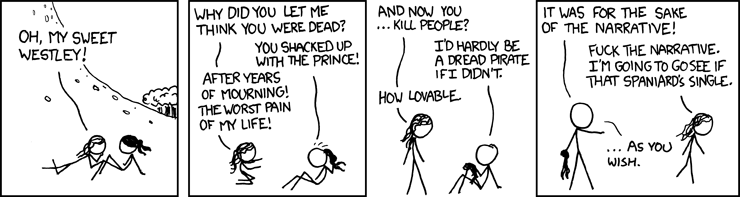
Also, because I cannot resist the pairing of narrative, pirate, and the Princess Bride, xkcd brings us:


*Actually, for
geneaological purposes, Variety Pirate Theater 3000 (as one friend has termed it) will proceed in chronological order beginning with the 1921 silent film The Sea Lion. The Princess Bride was mostly just for fun. Below is our list of films:

1921- The Sea Lion
1926- The Black Pirate
1933- In the Wake of the Bounty
1935- Captain Blood
1935- Phantom Ship
1936- Captain Calamity
1938- The Buccaneer
1939- Mutiny of the Elsinor
1940- The Sea Hawk
1942- The Black Swan
1948- The Pirate
1950- Buccaneer’s Girl
1950- Double Crossbones
1952- Against All Flags
1952- Blackbeard the Pirate
1952- Mutiny
1952- Pirate of the Blackhawk
1952- Yankee Buccaneer
1953- Peter Pan
1955- Long John Silver
1956- Manfish
1956- The Buccaneers (The Complete Series)
1982- The Pirate Movie
1987- The Princess Bride
1991- Hook
2003- Peter Pan
2003- Pirates of the Caribbean: The Curse of the Black Pearl
2004- The Life Aquatic with Steve Zissou
2006- Pirates of the Caribbean: Dead Man’s Chest
2007- Pirates of the Caribbean: At World’s End