THE BUCCANEERS OF AMERICA(N UNIVERSITY)
Comprising a Pertinent and Truthful description of the principal Acts of Research and Writing on the subject of representations of Pyrates
Showing posts with label pop culture. Show all posts

Thursday, January 28, 2010

VII. What is language?

Erin:
If you do come up with such an equation, let me know and I'll construct a multi-colored graphical representation of it :) However, I think that doing in doing so, I would miss the point just as much as J. Evans Pritchard, PhD does (http://www.youtube.com/watch?v=wOENu0fK0uM). Much to the chagrin of the analytic philosophers, ordinary language, like poetry, simply doesn't map neatly onto the Cartesian coordinate system, let alone onto the elegant symbolism of first-order logic. But, as Wittgenstein points out, it still *works.* Stuff happens when we call something "religious," even if its meaning is contested and vague. (Or perhaps more accurately, stuff happens because its meaning is contested and vague). So for things other than making the initial acquaintance of a new term or structuring the framework of a formal debate, I don't think dictionary definitions are good for much. As far as analyzing the potential for the institutions of science and religion to coexist and work together in the real world, I think it's a lot more helpful to look at how the words are thrown about, as cavalierly as they may be. Then too, I have no particular investment in labeling Sagan as religious or not, since it doesn't really affect my position one way or the other. That's your and PTJ's fight and, as we lack a universal shibboleth for all religion (as opposed to Christianity's handy little test of faith: http://www.youtube.com/watch?v=D5RGxE2_G0I ...), I fear such a debate is going to devolve into a speculative interpretive attempt at getting inside Sagan's head which seems to be an explicitly non-empirically verifiable exercise. As you point out, Einstein used religious language to legitimate his work to a popular audience; I don't think we can judge whether or not he (or anyone else) was ACTUALLY religious from his writing -- just whether or not he used the language of religion, then, more interestingly, what might have caused him to do so and what the effects of doing so were (are ...).

Didn't mean to imply the consumption of spaghetti was mean-spirited when I said it was mocking. (Tell me, though, was there transubstantiation involved or was it a symbolic act of consubstantiation? Or merely an instantiation of that age-old tradition of communion, in the original sense of the word? )

As for people being idiots, I don't think irrational decision-making, inaccurate risk-assessment, or poor driving skills is much of a defense of this position, since irrationality and misperception of risk are pretty much universal. They're puzzling phenomena, to be sure, but they don't have much (any-) thing to do with intelligence. And I don't think "people are idiots" is a particularly compelling account of such behavior. It's got about as much explanatory power as the version of rational choice theory that assumes all people are rational decision-makers then proceeds to explain how they act rationally in any given situation. I'm not convinced that parsimony (your Occam's razor account) is all that important an epistemic value in social explanation.

With regard to ketchup, there is clearly a difference between the two products ... but both are called "ketchup." Why? How were advertisers able to convert mustard into a Veblen good while still labeling it "mustard," but the same was not true of ketchup? Why do people think, as Moskowitz suggests at the end, "ketchup is ketchup" but not "mustard is mustard"? The only way to answer these questions is to look at how the words are used within the social context of the condiment market ... A dictionary definition of "ketchup" or "mustard" is not going to answer those questions anymore than an entry for "flipped" is going to mention the French Prince of Bel-Air: http://www.qwantz.com/index.php?comic=1428

Chris:
Everything can be mapped into logical statements as long as they're precise enough. It's just a matter of finding all the lurking variables.

I used driving as a single example (not to mention the oblivious pedestrians and bikers one always sees, not to mention again the errors in planning the roads, not to mention the errors of people who don't pay for their roads to be maintained properly, not to mention the fact that the problem stems from improper training due to our low standards for drivers' tests set by idiots who decided that anyone should be able to pass them, a chain of idiocy that pervades almost everywhere). I don't really care if it's a compelling account of such behavior; it's easy to say and gets my point across exactly.

People are idiots; there's no way around that. P.T. Barnum once (probably) said, "Nobody every went broke underestimating the intelligence of the American people," and I don't think anyone's improved upon that quip yet (maybe Dr. House, early seasons).

In terms of the epistemic value of parsimony - The point of the rule of parsimony is to get rid of stuff you don't need. It is therefore invaluable in any endeavor that either wants to be understood, wants to understand things, or both.

You know my favorite thing about any postmodern accounts of language? Actually, two: one, they completely ignore Chomsky or anyone intelligence; and two, like all postmodernists, they use deliberately confusing language to hide the fact that they're bullshitting people. The last piece of postmodernism I appreciated was Pulp Fiction, and that came out in 1994. I can't be bothered to engage postmodernism because I'm reasonably certain it will give me an unnecessary heart condition. Which, to be fair, science and not religion will eventually cure.
Erin:
No, you're wrong. First of all Frege invented and the Vienna Circle made use of formal logic as an alternative to and improvement on everyday language, not a representation of it. The logicians saw language as it is spoken as an impediment to philosophical inquiry, not as constitutive of it (except perhaps as constitutive of philosophical "problems" ...). In the Tractatus, Wittgenstein did see logic as the fundamental form of language, but such an interpretation is only useful for generating a theory of truth or a theory of language-- fun philosophical problems, if you're into that kind of thing, but certainly not explanatory theories of how the world works. They weren't intended to be. All of the hard core advocates and developers of formal languages I've read (/about) so far have seen their systems as heuristic devices for solving philosophical problems, not as accounts of the real world. Tarski, for instance, admits that there might well be insurmountable difficulties in applying his semantic conception of truth to ordinary language.

In any case, to map concepts like connotation and reference and "improper" or imprecise uses of language into a logical system would require so many logical operators (you'd need one for every way in which a word related to another word ...) that you'd just end up with a reproduction or translation of the language we speak today. Similarly, while accounting for all the variables that exert causal influence over how we use language might be theoretically possible, it is practically untenable. It's like Mill's argument that it is theoretically possible to predict an individual's actions if we know everything about that person and his or her context -- but that we can never, operating in the real world, know all that, so we need different methods for the social sciences.

I'm sure it was easy for you to say that "people are idiots," but I'm honestly not sure what the point of that sentiment is, besides misanthropy. You haven't defended it as an explanatory account of human behavior (as I argued before, in explaining everything, it explains nothing) -- and it certainly doesn't generate any insights, let alone predictions. Why didn't the US militarily threaten the UK during the Suez Crisis? Why did the US become involved with NATO intervention in the Balkans? "Because they were idiots"?

As for refusing to engage with anything you deem "postmodern," with all due respect, I think that's a pretty cowardly and intellectually close-minded position. I went into this at some length this summer, so I'll direct you here: http://roguishcommonwealth.blogspot.com/2009/06/dissent-dissent-on-pirate-blog.html as Thomson raises similar arguments to yours. By all means, critique the substance and merits of my arguments (as you have been) but don't slap the label "postmodern" on them and whine about confusing and obfuscatory language. I find advanced scientific language confusing and obfuscatory. Why? Mostly because a fairly sophisticated and specific vocabulary is needed to address complex subject matter, and I don't happen to be familiar with it. I know Chomsky claims he'd never be able to learn the language of postmodernism but a) I think that's laziness and b) I sincerely doubt I've used any such language in this conversation. If I have, by all means, call me out on some specific instances and we can talk about those! In any case, what I'm arguing for here is a method of understanding the social world that pays attention to the causal role the use of language plays in the social world, not a philosophical project of revealing hidden structures of violence and oppression, which is primarily what Chomsky's critique deals with.

Chris:
It's still interesting to me, as a thought experiment, to imagine the complexity of language broken down. As I mentioned, I am not prepared to actually do it. However, I do not believe in irreducible complexity; it seems to me that there should be some way to break things down. I do not mean to imply that I am rewriting the history of rewriting language. Again, it is a thought experiment.

As is, so far as I'm concerned, the idea that it is possible to predict an individual's actions. To me, that's more of an intellectual litmus test than a sincere endeavor. (I do not doubt, though, that we will eventually come up with technologies that can do exactly what we're describing. It'll just take a long time.)

"People are idiots" is shorthand.

I like the irony that I mis-typed the word "intelligent."

It is impossible to call someone a coward with "all due respect."

Like all things, postmodern writing follows a bell curve where most of the middle stuff is okay, but not particularly interesting. Those average people of all disciplines try to cloak their uselessness in confusing language. I just end up seeing more postmodern crap than other crap. I did not mean to accuse you of using such language.

On a deep level, I just can't stand postmodernism. It may be intellectually weak of me to not continue to engage postmodernism, but it will make me a small measure happier. You may treat this as intellectual weakness, primarily because it is, but I am ill-equipped to continue. Sorry.
TO BE CONCLUDED ...

Tuesday, August 18, 2009

Descending from the heights, part Zombie!

Nope, we're not talking about "cruel, demented, vicious pirates who cannot be killed," though that's interesting too:


But rather, as has been extensively well-documented on the pirate blog, Catherine and I are perhaps understandably concerned with being taken seriously, not in spite of, but rather because of, our study of something as popular as pirates. So we're always on the look-out for cases where popular culture is treated as analytically relevant to scholarly research, and the BBC today was happy to oblige. According to an article entitled "Science ponders 'zombie attack'," mathematical researchers at the University of Ottawa have used the hypothetical scenario of a zombie attack as an exercise in infectious disease modeling.

Professor Robert Smith? (the question mark is part of his surname and not a typographical mistake) and colleagues wrote: "We model a zombie attack using biological assumptions based on popular zombie movies. We introduce a basic model for zombie infection and illustrate the outcome with numerical solutions."
The researchers only considered old-school slow zombies, but even so, the results were worrying:

... their analysis revealed that a strategy of capturing or curing the zombies would only put off the inevitable. In their scientific paper, the authors conclude that humanity's only hope is to "hit them [the undead] hard and hit them often". They added: "It's imperative that zombies are dealt with quickly or else... we are all in a great deal of trouble." According to the researchers, the key difference between the zombies and the spread of real infections is that "zombies can come back to life".
This study (available in full here) is an example of the "popular culture as a mirror" approach outlined in the introduction to Harry Potter and International Relations (11-13), as can be seen from the article's abstract:

Zombies are a popular figure in pop culture/entertainment and they are usually portrayed as being brought about through an outbreak or epidemic. Consequently, we model a zombie attack, using biological assumptions based on popular zombie movies. We introduce a basic model for zombie infection, determine equilibria and their stability, and illustrate the outcome with numerical solutions. We then refine the model to introduce a latent period of zombification, whereby humans are infected, but not infectious, before becoming undead. We then modify the model to include the effects of possible quarantine or a cure. Finally, we examine the impact of regular, impulsive reductions in the number of zombies and derive conditions under which eradication can occur. We show that only quick, aggressive attacks can stave off the doomsday scenario: the collapse of society as zombies overtake us all.
Meanwhile, on his Foreign Policy blog, Daniel Drezner briefly and light-heartedly applies some theories of International Relations to a zombie attack. While Drezner's analysis is not fully fleshed-out (sorry!), a brief survey (n=3) I conducted in the last 5 minutes unanimously suggests that zombies should probably be considered alongside Kosovo to understand IR theory. As Daniel Nexon and Iver Neumann write, "The mirror approach is broader than simply deploying popular culture artifacts as a teaching aid. IR scholars can examine popular culture as a medium for exploring theoretical concepts, dilemmas of foreign policy, and the like" (12). As an important caveat, 2/3 of respondents conditioned their response on zombie attacks, unlike extraterrestrial visitations, remaining confined to the realm of hypothetical thought experiments.

Saturday, August 1, 2009

Captain Blood .... in Space!

We've been meandering our way through some famous pirate movies of the early 20th century this summer (since the pirate discourse shifted to the silver screen from the 1920s onward) and one of the less interesting pirate movies we've watched has been Captain Blood. Although it held great promise, what with the dashing charms of Errol Flynn, the background of the Monmouth Rebellion, a man named Blood, and swashbuckling on the high seas, it was actually marked only by the quicksilver shifting of the protagonists' motivations and character, the incomprehensibility of the plot, and a grand total of one somewhat lackluster sword fight. (Please note this is not a sneering condemnation of old movies held up against the glittering, CGI-enhanced jewel of Pirates of the Caribbean; The Black Pirate from 1926 was an infinitely more exciting film with several way-cool sword fights.)

However, in complete disregard for my lousy review, it turns out that Warner Brothers are playing to remake Captain Blood ... by setting it in outer space! Producer Bill Gerber explains:

"When it comes to swashbuckling, you just couldn't go back to the pirate era, not once you've experienced the juggernaut that is 'Pirates of the Caribbean,' '' he explains. "So we needed to find a new way to tell the story."

For Gerber, the best option was not a present-day story involving the Somali pirates -- who are probably too vile and desperate to base an entertainment around -- but a story set a couple of hundred years in the future. "It's still the classic 'Captain Blood' storyline: Peter Blood has been wronged by the powers-that-be and he wants to get even. But the best way to recreate that is by putting it in space, where you can have a totalitarian style of government that's actually pretty similar to what England was like in the 17th century."

This is some pretty informative commentary, as it notes both the shifts that happened in contemporary pirate discourse that accompanied Pirates of the Caribbean as well as the Somali pirate attacks. And while I'm a bit skeptical of sword fights in outer space, there's precedent for space pirates and Geoff Boucher imagines a "live-action version of the Disney film Treasure Planet" which was sort of ok. Ultimately, there's no doubt that, far from being "a partnership that never should have begun," the new Captain Blood has the potential for great box office success, bringing together as it does three of America's favorite things to watch on screen: space, pirates, and (if this LA Times blogger has his way) Robert Pattinson.

Here, for your entertainment, is the swashbuckling scene from the 1935 Captain Blood (skip ahead to 3:44):

Tuesday, July 21, 2009

Research trip, part V: North Carolina


Our trip to down to North Carolina was a pleasant change from the long days we spent overly air-conditioned windowless reading rooms on our earlier academic voyages. (Though as should be evident from the slew of posts below, I clearly have no shortage of affection for the resources such halls contain.) We traveled to Beaufort, North Carolina to talk to David Moore, an nautical archaeologist who is currently excavating Blackbeard's flagship the Queen Anne's Revenge and an expert on Blackbeard. Because the popular imagery and myths surrounding Blackbeard have exerted a considerable influence on contemporary conceptions of pirates and piracy, Blackbeard, like Buccaneers of America, makes a good case to trace through history.

We learned several interesting and significant things in the course of this interview, including changes made to the 2nd edition of Johnson's
A General History of the Pyrates which point to increased dramatization of the subject matter. At one point, the first edition has Blackbeard marooning some men on an island with no inhabitants or provisions; in the second edition, this account has been embellished to say that there was neither bird, beast, or herb for their subsistence -- an unlikely story given the presence of fresh water on North Carolina's Outer Banks. Even Johnson's famous description of Blackbeard indicates considerable dramatic excesses:
So our Heroe, Captain Teach, assumed the Cognomen of Black-beard, from the large quantity of Hair, which, like a frightful Meteor, covered his whole Face, and frightened America more than any Comet that has appeared there a long Time. This beard was black, which he suffered to grow of an extravegant Length; as to Breadth, it came up to his Eyes; he was accustomed to twist it with Ribbons, in small Tails, after the Manner of our Ramilies Wiggs, and turn them about his Ears. In Time of Action, he wore a Sling overe his Shoulders, with three Brace of Pistols, hanging in Holsters like Bandaliers; and stuck lighted Matchs under his Hat, which appearing on each Side of his Face, his Eyes naturally looking fierce and wild, made him altogether such a figure, that Imagination cannot form an Idea of a Fury, from Hell to look more frightening.
According to Moore, the only eyewitness account of Blackbeard is in Henry Bostock's deposition where the pirate is desribed merely as "a tall, spare man with a black beard which he wore very long." We were also intrigued to learn that Moore knows when a new Pirates of the Caribbean movie has been released based on the sudden spike in interest in his work, mainly among schoolchildren working on history projects. He also equated the enthusiasm and excitement surrounding the finding and excavating of the Queen Anne's Revenge with the similar emotions evoked by Pirates of the Caribbean, which indicates just how strongly the contemporary popularity of pirates is linked to their historical origins (however historically inaccurate current representations may be). Moore also kindly provided with an excellent annotated bibliography of primary and secondary sources on piracy, making note of the ones that had passed his litmus test of credibility by getting the sections on Blackbeard right.

The interview was productive, the North Carolina Maritime Museum both free and informative, and the free day we spent at the beach sunny and relaxing. We also took a great deal of delight in the pirate-themed atmosphere that pervades the town of Beaufort:


The following day we headed back up to Raleigh, where the North Carolina Museum of History has an exhibit on piracy called Knights of the Black Flag, skillfully curated by the Maritime Museum who donated many of the artifacts on display from the Queen Anne's Revenge. We didn't learn much relevant to our project at the exhibit -- not through any fault on its part, but because we have spent the last three months immersing ourselves in this very material. In that sense it was a gratifying visit, and we certainly enjoyed seeing depictions of and artifacts from the stories we've been treating with such academic disinterest. Here is the pirate flag we designed on a computer there, using common symbols of piracy:


The definite highlight of the exhibit, however, was the hands-on section where they had pirate costumes to try on and a model pirate ship to clamber upon -- clearly necessary components of our research. Here is Catherine as Blackbeard:


And here are some pictures depicting serious scholarly investigation at the history museum:


Thursday, July 2, 2009

Deconstructing the vegetable-pirate nexus

Aaargh-tichokes, Piradishes, and Cuke-aneers: Deconstructing the vegetable-pirate nexus
Erin Lockwood, American University
From: The Journal of Critical Leguminous International Inquiry, 1, (2009): 1-2.

Introduction

Political discourse and official policy have shown an increased openness to discussions of fruits and vegetables previously considered outside the boundaries of civilized consumption practices, often rhetorically delegitimized through the heteronormative interpellation of such legumes as "crooked," or, colloquially, "wonky." Taking advantage of this recent discursive trend towards the re-introduction of vegetable-based rhetoric into the political sphere and drawing exclusively upon the methodologies of scholars whose names begin with "J" -- specifically J. Weldes, J. Derrida, J. Bially-Mattern, J. Butler, J. Baudrillard, J. Habermas and, perhaps unconventionally, J. Child -- this article analyzes the nexus between the identities of two intersubjectively constituted and otherized social actors -- pirates and vegetables and, more significantly, suggests that the deployment of rhetorical linkages between pirates and vegetables is no different from a patriarchal hegemonic deployment of traditional, weapons-based forms of "power" and "control."

Literature Review
A Google Scholar search of pirate + vegetable reveals that there is no current scholarship on this subject. A troubling find, and one indicative of the extent to which the association of pirate with vegetable has become one characterized by the Gramscian conceptualization of "commonsense."

Methodology
This study is occasionally a small n (n = 2) case study of cultural representations of pirates and vegetables and draws upon the theories and methods of the scholars whose names start with "J" cited above, some of whom say that methodology is inherently Western and rational and that deconstruction is non-method, and some of whom think this is pretty silly. In a performative acknowledgment of the aporetic interpretations of "method" and the liminal identity of both pirates and vegetable in the contemporary collective consciousness my meta-(non)method is therefore to oscillate very quickly between method and non-method while eating my not organic-certified carrot sticks in a politically aware manner.

Findings
Case 1:
One of the seminal basic disourses of the pirate-veggie nexus is found in a deceptively simple 20th century cinematic work of neo-Christian theology ostensibly aimed at children (though like so many other instantiations of so-called popular culture, this work is, to my mind, indicative of much more deeply buried -- indeed, repressed -- processes of repression and dehumynizaton) . This minimalist musical performance rhetorically links these societally marginalized identities with Weber's conceptualization of the capitalist-enabling Protestant work ethic -- or rather, in the Hegelian tradition, with its antithesis. But my interpretation -- indeed, any interpretation -- can only take us so far. Here is the piece in contention:


Case 2
The second basic discourse examined in this study engages in a similarly cartoon-like visual depiction of vegetable pirates -- a form of representational distancing between the perceived "reality" of the politically problematic nature of vegetable consumption and violent non-state actors and the harmless simulacra of the cultural deployment of these identities:
If you have fond memories of playing Pac-Man in your youth, your kids now have an opportunity to discover the fun of controlling a large-mouthed character who likes to eat. With Namco Bandai's The Munchables for the Nintendo Wii, kids come to the rescue of a world being attacked by alien veggies and fruits.All this eating is done in the context of a story about the peaceful but voracious Munchables society whose food is provided to them in great abundance by a set of Legendary Orbs. Space pirates shaped like fruits and vegetables and led by Don Onion have attacked the Munchables' world and stolen their Orbs. These bad guys are now arriving in hordes to put down their vegetarian roots. Luckily, they taste good to your Munchable character who has been recruited by the Great Elder to save the Munchables' world.
But whereas the previous discourse playfully acknowledges the religious origins of modern capitalist oppression by poetically and rhetorically linking the antithesis of the Weberian ethic to vegetable simulacra in a Christian-infused hyperreality, the second case deploys similar representations in a normatively hegemonic wielding of inherently Western nutritional values. By exploiting the commonsense associations of pirates with vegetables, this text implicitly but transparently associates the forbidden fruit (if you will) of these otherized identities with its aggressive imperialist vegetable-consumption agenda while normalizing violence by reifying the character of postmodern warfare in a seductively deceptive simulation of death and destruction:
Like Pac-Man,The Munchables creates addictive game play — it's fun to eat everything in sight. For parents concerned about violence, this is an E-rated game. But it does contain mild violence because you do eat cute anthropomorphized fruits and vegetables. There is no blood or agony — the interloping pirates just disappear into your character's maw as you become the hero for restoring order in your world.
Conclusions
I need to spend less time in the library.

Saturday, June 13, 2009

"Murdered by pirates is good!"

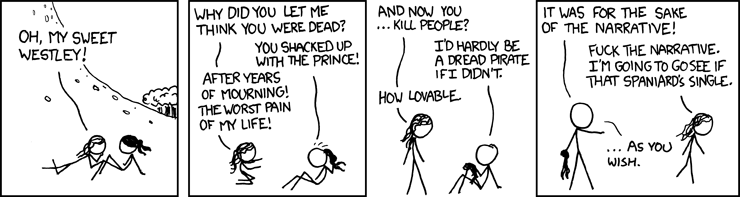
Last week Catherine and I sort of* kicked off our watching of pirate movies with an old favorite and one of the cleverest works of modern cinema: The Princess Bride. We were, of course, observing carefully the representation of the Dread Pirate Roberts (quite possibly an homage to Bartholomew Roberts), and this line, in particular, caught our attention: "Then he explained that the name was the important thing for inspiring the necessary fear. You see, no one would surrender to the Dread Pirate Westley." This was welcome -- if happily non-academic -- support for our strong conviction that names matter. Below, for your unmitigated enjoyment, is the scene from the Fire Swamp where Westley explains the history of the Dread Pirate Roberts (beginning at 1:20):


Also, because I cannot resist the pairing of narrative, pirate, and the Princess Bride, xkcd brings us:


*Actually, for
geneaological purposes, Variety Pirate Theater 3000 (as one friend has termed it) will proceed in chronological order beginning with the 1921 silent film The Sea Lion. The Princess Bride was mostly just for fun. Below is our list of films:

1921- The Sea Lion
1926- The Black Pirate
1933- In the Wake of the Bounty
1935- Captain Blood
1935- Phantom Ship
1936- Captain Calamity
1938- The Buccaneer
1939- Mutiny of the Elsinor
1940- The Sea Hawk
1942- The Black Swan
1948- The Pirate
1950- Buccaneer’s Girl
1950- Double Crossbones
1952- Against All Flags
1952- Blackbeard the Pirate
1952- Mutiny
1952- Pirate of the Blackhawk
1952- Yankee Buccaneer
1953- Peter Pan
1955- Long John Silver
1956- Manfish
1956- The Buccaneers (The Complete Series)
1982- The Pirate Movie
1987- The Princess Bride
1991- Hook
2003- Peter Pan
2003- Pirates of the Caribbean: The Curse of the Black Pearl
2004- The Life Aquatic with Steve Zissou
2006- Pirates of the Caribbean: Dead Man’s Chest
2007- Pirates of the Caribbean: At World’s End

Sunday, May 31, 2009

Did you just walk out of The Pirates of Penzance?

Last night, my keen sense of duty overcame any general lack of enthusiasm for musical theater that I may occasionally express, and I went (with catlike tread) to see the New York Gilbert & Sullivan Players perform The Pirates of Penzance at Wolf Trap. It was quite fun to see it performed live with great gusto, good humor, strong voices, and a few updated jokes for the DC crowd. According to my thoroughly unscientific survey of the crowd on the lawn, there was at least one large group of people in full pirate dress and several spectators sporting pirate hats and skull-and-crossbones head scarves, which, in addition to to full house, indicates pirates are as popular as they were in 1879.

David Cordingly, author of
Under the Black Flag: The Romance and the Reality of Life Among the Pirates, notes that the operetta is a deliberate parody of Victorian-era melodramas featuring pirates as villains who terrorize the sea and discusses Penzance's influential role in shaping contemporary images of pirates:
The story is sheer nonsense and revolves around the mistake made by Ruth, "a pirate maid of all work," when she apprentices Frederick [sic], the hero, to a pirate instead of a pilot. The pirates themselves are as genial and ineffective as the policemen who are sent to catch them, but a complicated plot ends happily with Frederick marrying the Major-General's pretty daughter, Mabel, and the pirates revealed as patriotic noblemen who will no more go a-pirating. In spite of its lighthearted approach to the subject, The Pirates of Penzance has had a considerable influence on the way many people view pirates today. For more than a hundred years it has been performed by amateur and professional companies around the world, and its cast of hearty and good-natured fellows have contributed to the illusion that pirates were really misunderstood ruffians who never meant to harm anyone. (25)
Whether because of its piratical theme or the influential (and G-rated) wit of Gilbert and Sullivan, The Pirates of Penzance has clearly endured better than the melodramas it set out to parody; The West Wing, for example, would not have had much luck working The Red Rover, or The Mutiny of the Dolphin (which was immensely popular in 1829, though described by one critic as "arrant trash") into its scripting, though it had no such trouble with Gilbert and Sullivan's works in "And it's surely to their credit."


And, given its longevity and silliness, it is perhaps unsurprising that The Pirates of Penzance has itself become the object of parody (and subject to the same confusion with H.M.S. Pinafore -- "they're all about duty") by none other than the Animaniacs in "H.M.S. Yakko."

Friday, May 29, 2009

Oh, the other kind of RPG

With contemporary piracy still very much in the news (though bad weather may change that) and insurgents in Mogadishu further tearing apart the minimal trappings of Somali state authority while threatening to turn the country into a proxy war for Ethiopia and Eritrea, the popularity of pirates continues unabated. Given stories like this one:


it is not surprising that my first thought upon reading a headline about pirates and RPG's went to weapons technology and not entertainment. However, it appears that Disney has announced the creation of a role-playing game (RPG) called Pirates of the Caribbean: Armada of the Damned that they will release in 2010. The game seeks to capitalize on the popularity of the movies and (one assumes) on the recent upswing in piracy news, but according to Game Director Alex Peters, the idealization of individual liberty associated with pirate identity is also an important part of the game:
[W]e want to make sure our game creates a sense a freedom in how you decide to live your pirate life ... Since the player is cast in the role of a pirate, they may choose to involve themselves in situations that pique their interest or serve their own purposes.*
The game is not aiming for historical accuracy, but it does acknowledge the moral ambiguity of piracy, the prevailing economic conditions, the historic distribution of state power in the Caribbean (or lack thereof), and the importance of a pirate ship's crew.

In an even more explicit Hollywood connection, Columbia Pictures acquired the rights to the story of Captain Richard Phillip's capture by Somali pirates and subsequent rescue by US Navy SEALS (answering a question posed on the Duck of Minerva and discussed here a couple times in the past month). Here's a brief statment about how Columbia Pictures plans to narrate the story:
"We were drawn to this remarkable story of heroism and courage as events were unfolding off the coast of Africa," Doug Belgard, co-president of Columbia Pictures, said in a statement.
This suggests that the Somali pirates will be cast fairly unambiguously (and unsurprisingly) as the bad guys, in stark contrast with their role in the Pirates of the Caribbean films, highlighting the gap between perceptions of contemporary pirates and portrayals of historic ones.

Finally -- because pirates are still kid-friendly --LEGO has a new pirate ship set out, reviewed by John Baichtal at Wired. He thinks the set's pretty great (and with good reason -- this LEGO pirate ship actually lets you fire cannon balls!), but can't help noting how it fits into the greater construction of piratical identity:
Speaking of soldiers, like many LEGO sets, Brickbeard’s Bounty comes with a readymade conflict. The cartoon storyline depicted in the instructions shows a pair of hapless soldiers arriving in a rowboat with a chest full of gold and jewels, which they give to the pirates in exchange for the Admiral’s daughter. Any question who the real stars of the line are? (And does anyone else find it ironic that LEGO is selling a toy that shows authorities ransoming a hostage from a group of pirates?)
Yes. Yes, they do. Competing and dynamic narratives of piracy are the essence (eeps!) of this project, though, so more than ironic, I find it a fascinating puzzle.

*I'll have more on libertarianism and pirates in a future post.

Wednesday, May 27, 2009

Descending from the heights, Part the Third

(Are you really going to post about every academic source you can find that legitimates the use of pop culture in IR research? Yeah, probably. It's very exciting!) From Lene Hansen's Security as Practice: Discourse analysis and the Bosnian War:
Analysis investigates whether popular representations reproduce or contest those of official discourse and how representations travel between the spheres of entertainment and politics (Shapiro 1990, 1997). Studies of popular culture include film, fiction, television, computer games, photography, and comic books. It analyzes, for instance, how a particular region, country, or people is cinematically represented (Iordanova, 2001) or how espionage is treated within popular fiction (Der Derian 1992) ... Poststructuralist analysis has often focused on popular culture, but analyses of 'high culture' might be equally valid (and the definition of 'popular' should be extensive and historically situated) in showing, for example, how music, poetry, painting, architecture, and literature have been employed in constructing national and civilizational identities. Travel writing in particular has been an important genre for communicating the construction of 'foreign places and people' to the Western public since the eighteenth century and has been employed by a large variety of professions: by merchants or emissaries; pirates and buccaneers; missionaries; explorers; warriors and Spanish Conquistadores; ambassadors; scientists (botanists and geologists) and engineers; and not least, tourists ... (62-63)
Indeed. Having begun to expand our reading list into the realm of secondary source pirate-related material, Catherine and I have observed that Alexander Exquemelin's 1678 Buccaneers of America (check out this interactive version on the Library of Congress's website) fulfills precisely the role that Hansen talks about. Essentially a very early piece of first-hand travel writing, Exquemelin's book (along with Charles Johnson's A General History of the Pyrates) has -- often explicitly -- informed many, many works on pirates that came after it, including contemporary sources like Benerson Little's The Buccaneer's Realm: Pirate Life on the Spanish Main 1674-1688 and Stephen Talty's Empire of Blue Water: Captain Morgan's Great Pirate Army, the Epic Battle for the Americas, and the Catastrophe That Ended the Outlaws' Bloody Reign.
We're not prepared to assert the direct sort of links Hansen talks about here:
Adopting these guidelines calls forth a variety of genres: from direct links to popular culture, as in the influence of Tom Clancy's novels on Vice President Quayle and Secretary of Defense Weinberger (Der Derian 1992: 195), to secondary sources creating stories of influence, as when John F. Kennedy was said to have been heavily influenced during the Cuban Missile Crisis by Barbara Tuchman's account of the outbreak of World War I in Guns of August (Der Derian 1992: 174), or popular academic works such as Samuel Huntington's The Clash of Civilizations, which was reported as being 'fashionable in America's foreign policy establishment' (Walker 1997c) (62).
Certainly, tracing the genealogy of modern conceptions of pirates requires a few more steps than the direct influence of Robert Kaplan's Balkan Ghosts on Clinton's foreign policy in the Balkans, but we look forward to looking at how we got from Exquemelin's hair-raising eye-witness accounts of 17th century piracy to Vice Admiral William Gortney, Commander of the U.S. Navy's Fifth Fleet, naming his dog Captain Jack Sparrow. And with President Obama referencing Treasure Island in an (albeit light-hearted) discussion of Somali piracy, it's hard not to accept, on some level, Hansen's points about the mutually constitutive nature of identity and policy.

Tuesday, May 26, 2009

And who be Elmo? Pirates set sail on Sesame Street

Having just purchased Daniel Sekulich's Terror on the Seas: True Tales of Modern-Day Pirates, now at home on the "contemporary piracy" shelf next to John S. Burnett's Dangerous Waters: Modern Piracy and Terror on the High Seas (I could mock the the formulaic tendencies of these titles too), it's easy to forget the comically romanticized image of pirates that sparked this project in the first place. However, as Tina Fey's portrayal of a pirate on Sesame Street demonstrates, the defanged image of pirates is alive, well, and teaching Elmo about books:


Nobody's accusing Sesame Street of being out of touch with scary realities (quite the opposite, in fact), but these cuddly Muppet pirates are, to mix nautical metaphors, 20,000 leagues away from the pirates in Sekulich's book. And yet, the possibility and success of both depictions depend, in a sense, on the same popular perception of pirates' "cool factor." This fairly incredible gap between puppets for the preschool crowd and terrorist references for browsers of the military history section of Borders Books points not only to the continued and broad-based popularity of pirates, but also to the sheer absurdity of treating "pirate" as an easily definable term that refers to a static empiric entity.

Thursday, May 21, 2009

Pirates sell crunchy snacks!

Today as I was Wikipedia-ing Pirate's Booty snack puffs*, I happened upon this extraordinary article from Fortune Small Business Magazine analyzing the marketing potential of the delicious snack's pirate mascot:
According to the pros at Character product mascots succeed when they embody a brand's inherent conflict. In the case of Robert's, founded in 1986 by ex-commodities trader Robert Ehrlich, with about $50 million a year in sales, the conflict is snack food that's fun to eat but is also good for you. (Its all-natural ingredients include spinach and kale.) Even the product names' Veggie Booty, Smart Puffs, and Nude Food combine these traits: healthy food that feels indulgent.

Robert's uses dozens of mascots, including a pilot, Sigmund Freud, and a mischievous-looking pirate on its signature product, Pirate's Booty. "These are characters who refused to accept the standard way of doing things, either by pioneering revolutionary approaches or by living outside the normal rules of society," explains Jim Hardison, creative director at Character.

The drawings are based on Ehrlich (except the Einstein-ish character on Smart Puffs, inspired by his father, Mel), but Hardison says the style of drawing is irreverent, fun is more important than the specific individuals shown. Here, Hardison's analysis of the pirate:

  • The character's eye is drawn in a way that tracks when you look at it, creating a connection with buyers. A concerned eyebrow and smile makes him mischievous, not evil or dangerous.
  • The cartooniness of the pirate supports that too, in that a realistic pirate is a dark, negative character who breaks laws. This is just transgressive enough to be fun without being threatening.
  • As Ehrlich expands overseas, he may want to replace the mascot in certain locales (such as the Caribbean, which was repeatedly plundered by pirates).
* When I told this story to Catherine earlier she expressed a bit of confusion over why I was Wikipedia-ing my snack food. Basically, I Wikipedia everything. You can learn a lot by doing this. QED.

Wednesday, May 20, 2009

Descending Even Further...

As Erin and I have begun wading into the pool of constructivist theory that we need to explore before starting on the pirate-y part of our pirate research, we've been rather surprised to see what an incestuous little family we've stumbled into. It's been fun, and vastly interesting to see who keeps citing whom and which scholars invariably end up in the acknowledgment section of everyone's books. One great example relates to Erin's last post about Jutta Weldes's fabulous quote on the importance of studying popular culture. This morning, I began reading the Harry Potter and International Relations book, edited by Daniel Nexon and Iver Neumann. (On a brief side note, as someone who dearly loves Harry Potter, I am totally reading this one all the way through for fun as much as research!). Jutta Weldes herself is mentioned in the acknowledgments section, but the best part is that the introduction contains a slightly more accessible version of her quote on popular culture that Erin just brought to our attention:
International-relations theorists often neglect second-order representations. They also view first-order representations as relatively unproblematic expressions of the "facts" of international politics. The speeches and debates of political elites are often the "stuff" of our investigations, whereas we usually treat books, films, and television as afterthoughts or indirect commentary on political events. For many purposes, there is nothing wrong with this mode of analyzing the social world. At the same time, both speeches and television dramas are representations of social life, and they interact with one another in a variety of important ways. We need to keep in mind that, for many people, second-order representations are often more significant sources of knowledge about politics and society. Popular entertainment not only commands a larger audience than the news or political events, but it frequently has a more powerful impact on the way audiences come to their basic assumptions about the world. (pg. 7-8)

Tuesday, May 19, 2009

Descending from the heights

Conducting research on something as, well, popular as pirates makes you somewhat inclined to go on the defensive as to the seriousness of your research and its importance to the study of "actual" international relations. So this concluding passage from Jutta Weldes' fascinating Constructing National Interests:The United States and the Cuban Missile Crisis provided some welcome theoretical validation for what we're up to this summer:
Recognizing the constitutive character of common sense, in turn, opens up a variety of other possible domains of inquiry that have often been overlooked in our attempts better to understand world politics. One such domain, I would argue, is popular culture. Students of international relations have rarely descended from the heights of interstate interaction to analyze the everyday cultural conditions that make particular state actions possible and that render them sensible to wider publics. But as I have suggested, these mundane cultural conditions are integral to rather than irrelevant for state action. It matters deeply that U.S. state actors are able to interpret and to define world politics in ways that at least significant portions of the U.S. population, and other audiences, find plausible and persuasive. The reproduction of common sense, and specifically of the grounds upon which particular representations are constructed and make sense, however, cannot be restricted to the representational practices of state actors. On the contrary, those representations are made sensible in no small part precisely because they fit with the constructions of the world and its workings into which diverse populations are hailed in their everyday lives. Representing world politics is not an unusual or extraordinary activity; rather, it is a relentlessly mundane and commonplace one. A key site at which that representation takes place, then, is in popular culture, in the everyday practices of meaning making that structure the quotidien. Perhaps it is time we devoted a little less attention to the doings of state actors and instead devoted a little more to the “silent” masses in whose name they claim to speak. (241-242)
In Wired for War: The Robotics Revolution and Conflict in the 21st Century, P.W. Singer has a similar, though (necessarily?) somewhat less academic, justification for the importance of popular culture as a site of research:
[T]his is how people process information most efficiently. Humankind has long best understood and digested things that new by flavoring them with stories of personal experience ("There was this one time, in band camp, where we...") as well as by allusions to what is already culturally familiar, especially icons, symbols, and metaphors ("It's just like when..."). And, whether we like it or not, our twenty-first century folklore is that of the popular movies, TV shows, music, gadgets, and books that shaped us growing up. (15)